
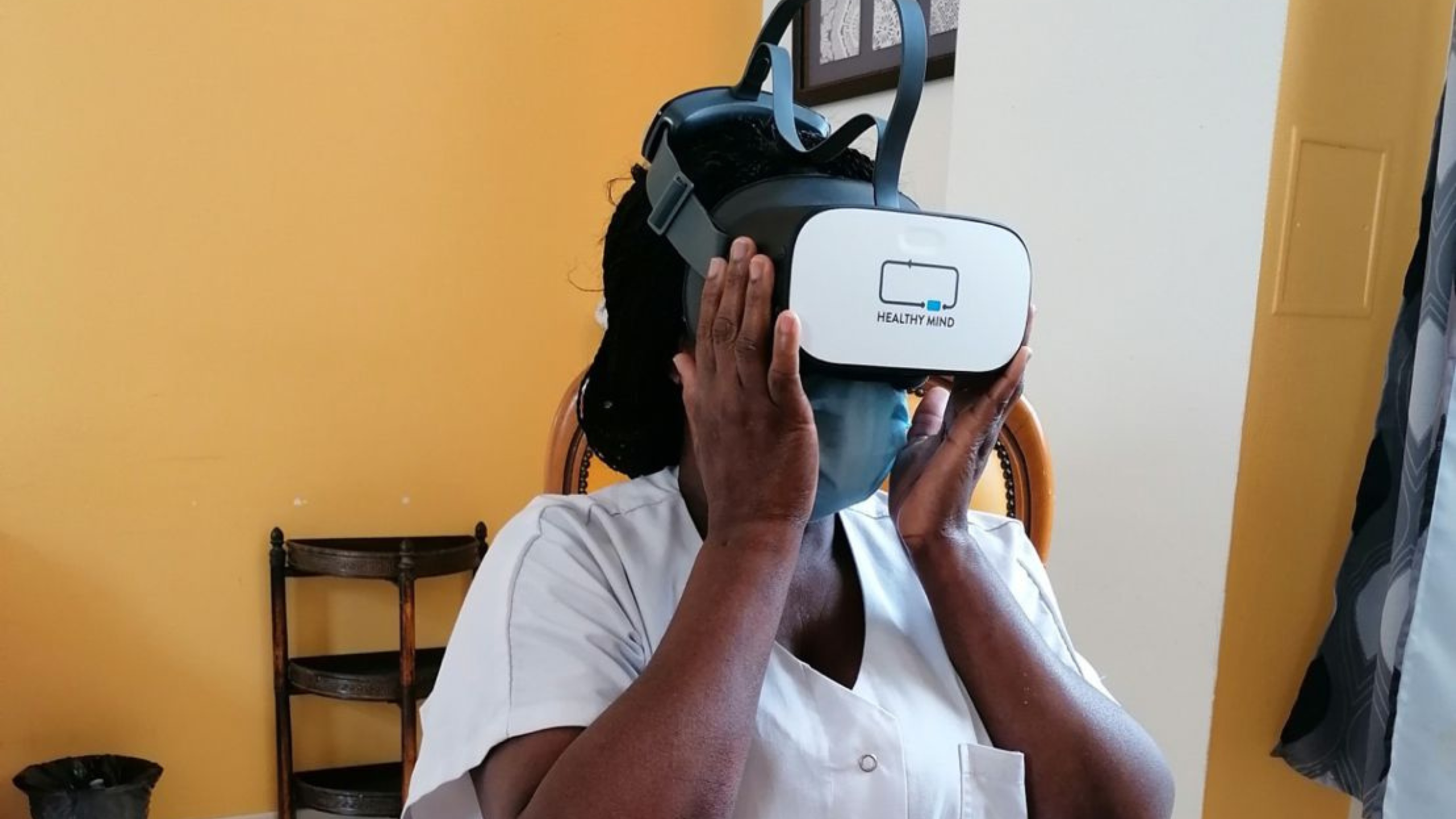
You put on a virtual reality headset and within seconds, your living room disappears. In its place, you admire a sunny beach, a lush forest or a snow-covered mountain. Even though you know you have not moved, you feel as though you are there, sensing the temperature and the ground beneath your feet. This stationary journey alters your perception of space, your body and your surroundings. How is this illusion created? Discover what we know about the impact of virtual reality on the brain.
Why does our brain react as if virtual reality were real?
The integration of multiple senses
When you walk down the street, your eyes perceive the buildings moving past you, your inner ear detects movements of your head, and your body provides information about its own position in space. The brain combines these signals to determine where you are and what is happening. This process is known as multisensory integration [1].
Virtual reality artificially reproduces part of this process. The VR headset displays an environment that changes with your movements and combines it with spatialised sounds. When this information is consistent, your brain integrates it into a coherent representation of the experience.
Even though you know you are safe in your living room, you may instinctively step back when faced with a virtual precipice, or even experience a feeling of vertigo. To your brain, the threat is not fictitious. Virtual reality temporarily changes the information on which it relies to perceive its surroundings.
The sense of presence
The sense of presence doesn’t refer to a dissociation that would make you imagine the virtual world as reality. During an immersive experience, you are generally aware that you are taking part in a digital experience. Yet your attention and some of your reactions immerse you in the experience and make you perceive the environment as though you were physically there.
When you move forwards in a virtual corridor, the image doesn’t remain static: it changes alongside you. The walls appear to move closer and the sounds change depending on your position. You know that it’s only a simulated environment, but your brain receives information that is sufficiently coherent to process this landscape as a space in which you are moving.
Presence is precisely one of the central concepts in virtual reality research. It is studied through users’ self-reported experiences, but also through behavioural and physiological measurements. A review focusing on presence and cybersickness highlights the role of sensory integration mechanisms in both phenomena [2].

How does virtual reality affect the brain?
Activation of numerous brain regions
Several brain regions become active when you immerse yourself in a virtual experience [3][4]:
- the visual cortex analyses the shapes, colours, movements and other graphical information displayed by the VR headset;
- the parietal regions contribute to processing the body’s position and organising information in space;
- the hippocampus and structures involved in spatial navigation play a role when you need to find your way around, remember an environment or locate a specific point;
- regions involved in emotional processing respond to the scenes presented and the memories they evoke;
- motor regions are engaged when you move your head, hands or body to interact with your surroundings.
An immersive experience creates a cognitively rich situation. The brain has to process several types of information simultaneously and update its representation of the environment according to your movements.
Stimulation of neuroplasticity
Neuroplasticity refers to the ability of your nervous system to modify its functioning and connections in response to experience, learning or following an injury. VR is a tool that can be used to provide a controlled, repeatable experience, with adjustable stimuli and movements.
Rehabilitation following a stroke is one of the areas in which this question has been studied extensively. A systematic review focusing on the effects of virtual reality on neural plasticity following stroke analysed 27 studies and reported changes in various markers of plasticity during rehabilitation interventions [5].

Can virtual reality alter our perception of the body?
Our brain constantly maintains a detailed representation of our body: where our limbs are, how they move and the extent to which they belong to us.
If you watch an avatar reproduce movements in real time, the boundary between your body and the virtual movements becomes more fluid and blurred. This phenomenon is known as the body ownership illusion. It’s part of the embodiment, which encompasses both the feeling that the virtual body is your own and of being the one initiating its movements.
A systematic review and meta-analysis of 111 articles focusing on these illusions in virtual reality concluded that embodying an avatar generally produces a sense of body ownership, as well as a greater increase in the sense of agency associated with that avatar [6].
For example, a review focusing on limb rehabilitation following stroke examined the use of the body ownership illusion in VR. The four studies meeting the review’s criteria suggested potential benefits for motor recovery [7].
What are the side effects of virtual reality on the brain?
Temporary cognitive fatigue
A virtual reality session places demands on attention, the visual systems and balance. A long or particularly stimulating immersion requires you to process new visual and auditory information and, in some cases, interact with the environment. A feeling of overload may then occur, alongside eye strain and discomfort.
This uneaseness doesn’t necessarily indicate lasting impairment of cognitive abilities or the brain. It simply means that it is time to take a break and step away from the experience to rest your eyes and mind.
Indeed, Anses (French Agency for Food, Environmental and Occupational Health & Safety) indicates that exposure to virtual reality can cause short-term, reversible effects, including temporary changes in sensory, motor and perceptual abilities [8].
Cybersickness
You are sitting still, but your headset shows that you are running. Your eyes register movement, while the information coming from your body and vestibular system doesn’t correspond. This sensory mismatch can cause virtual motion sickness, more commonly known as cybersickness.
A systematic review focusing on the adverse effects of virtual reality in therapeutic applications found disorientation, nausea and oculomotor disturbances among the symptoms frequently reported [9]. Anses considers cybersickness to be the main side effect of VR.

How Healthy Mind uses these mechanisms to support your well-being
The effects of a virtual reality experience depend partly on how it’s designed. The duration of the immersion, the headset used and, above all, the content provided all influence how the session is perceived.
The Healthy Mind solution was developed for therapeutic and well-being purposes. Virtual environments guide users towards relaxation without adding new sources of discomfort. To design our experiences, we work with a scientific committee made up of anaesthetists and hypnotherapists. We assess the anxiety-inducing potential of each element of the scenario in order to minimise the risk of unpleasant sensations as much as possible.
With this in mind, our immersions use a teleportation system rather than continuous movement to prevent cybersickness symptoms from occurring. By remaining stationary, the risk of virtual motion sickness is considerably reduced.
In addition, session length can be adjusted from 5 to 80 minutes to suit the context and the user’s experience. If the immersions are used within a professional therapeutic setting or in a clinical hospital setting, communication remains possible at any time via text message or microphone, allowing patients to remain in control of what they are experiencing.
A virtual reality headset is enough to alter our perception of our surroundings. Yet our brain doesn’t confuse the virtual world with reality: it interprets the information presented to it and adapts our experience accordingly. This ability explains both the power of immersion and some of its limitations. It also opens up possibilities for creating moments dedicated to relaxation, such as those we compose at Healthy Mind. If you would like to experience our immersions or discuss a collaboration, we would be delighted to offer you a demonstration.
References
[1] Stein BE, Stanford TR. Multisensory integration: current issues from the perspective of the single neuron. Nat Rev Neurosci. 2008 Apr;9(4):255-66. doi: 10.1038/nrn2331. Erratum in: Nat Rev Neurosci.2008 May;9(5):406. PMID: 18354398.
[2] Weech S, Kenny S, Barnett-Cowan M. Presence and Cybersickness in Virtual Reality Are Negatively Related: A Review. Front Psychol. 2019 Feb 4;10:158. doi: 10.3389/fpsyg.2019.00158. PMID: 30778320; PMCID: PMC6369189.
[3] Jäncke L, Cheetham M, Baumgartner T. Virtual reality and the role of the prefrontal cortex in adults and children. Front Neurosci. 2009 May 1;3(1):52-9. doi: 10.3389/neuro.01.006.2009. PMID: 19753097; PMCID: PMC2695391.
[4] Mellet E, Laou L, Petit L, Zago L, Mazoyer B, Tzourio-Mazoyer N. Impact of the virtual reality on the neural representation of an environment. Hum Brain Mapp. 2010 Jul;31(7):1065-75. doi: 10.1002/hbm.20917. PMID: 19967769; PMCID: PMC6870852.
[5] Hao J, Xie H, Harp K, Chen Z, Siu KC. Effects of Virtual Reality Intervention on Neural Plasticity in Stroke Rehabilitation: A Systematic Review. Arch Phys Med Rehabil. 2022 Mar;103(3):523-541. doi: 10.1016/j.apmr.2021.06.024. Epub 2021 Aug 2. PMID: 34352269.
[6] Mottelson A, Muresan A, Hornbæk K, Makransky G. A Systematic Review and Meta-analysis of the Effectiveness of Body Ownership Illusions in Virtual Reality. ACM Transactions on Computer-Human Interaction, 2023;30(5), Article 76. DOI: 10.1145/3590767.
[7] Ventura, S., Marchetti, P., Baños, R. et al. Body ownership illusion through virtual reality as modulator variable for limbs rehabilitation after stroke: a systematic review. Virtual Reality 27, 2481–2492 (2023). https://doi.org/10.1007/s10055-023-00820-0
[8] French Agency for Food, Environmental and Occupational Health & Safety (Anses), What are the risks of virtual reality and augmented reality, and what good practices does ANSES recommend?, june 2021.
[9] Simón-Vicente L, Rodríguez-Cano S, Delgado-Benito V, Ausín-Villaverde V, Cubo Delgado E. Cybersickness. A systematic literature review of adverse effects related to virtual reality. Neurologia (Engl Ed). 2024 Oct;39(8):701-709. doi: 10.1016/j.nrleng.2022.04.007. PMID: 39396266.